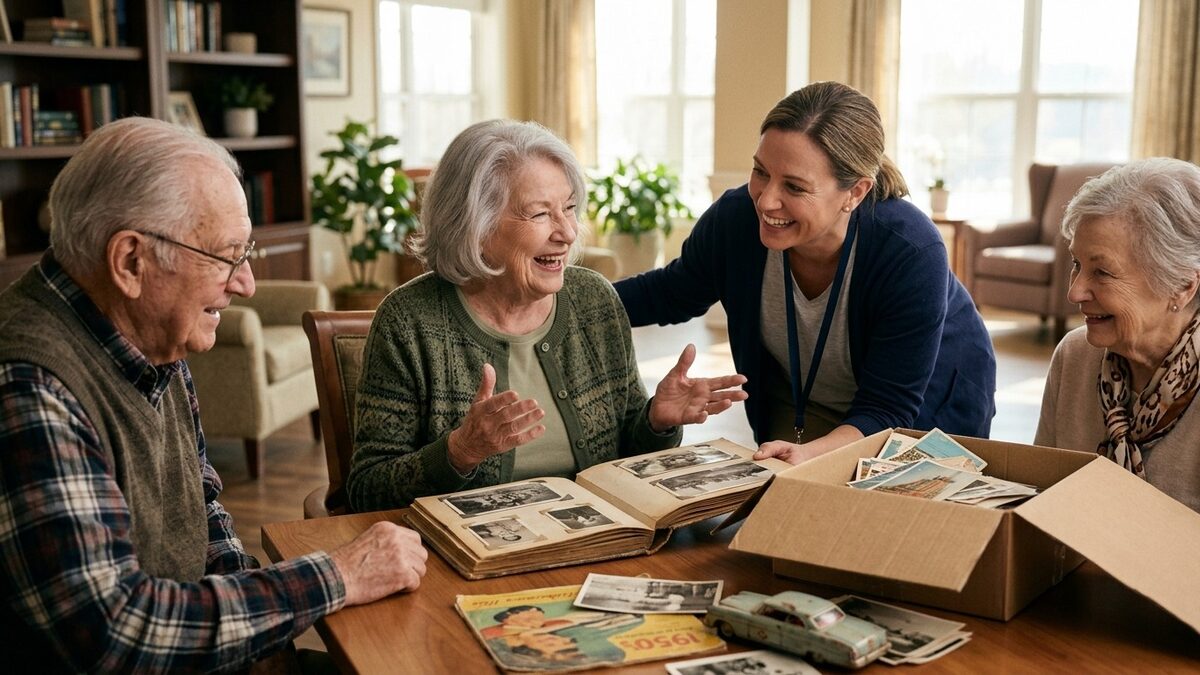
Brain Exercises for Seniors: 22 Daily Workouts for a Sharper Mind
August 8, 2026 · 8 min read
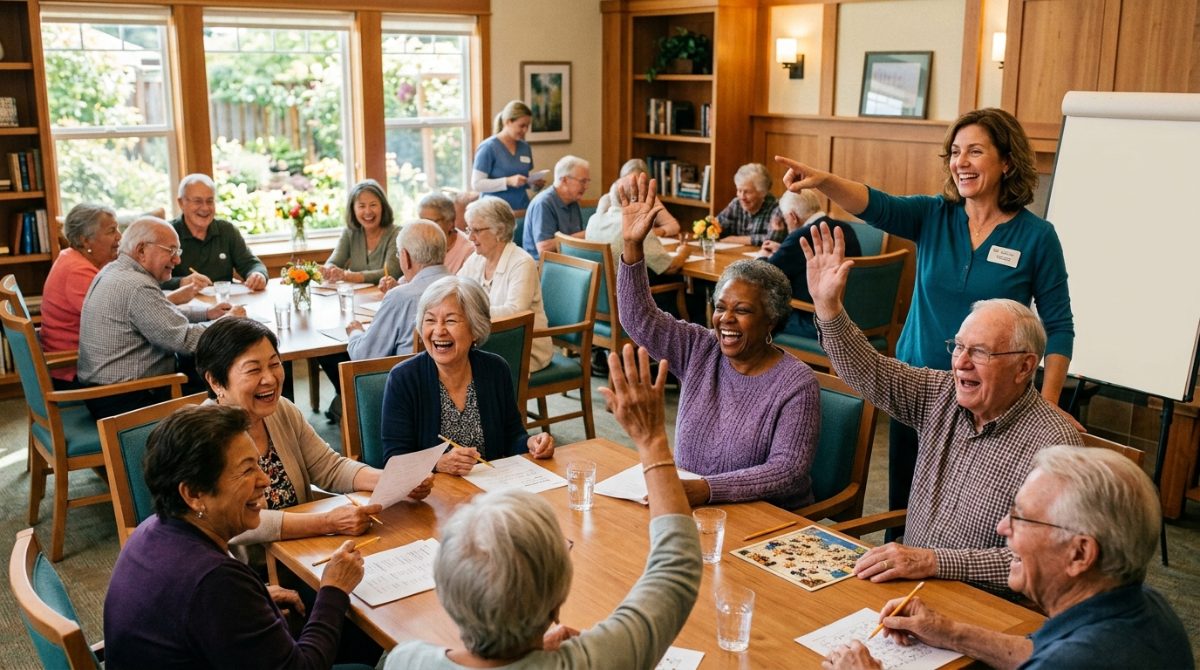
The brain responds to exercise the way muscles do: challenge it regularly and it adapts. For older adults, research links consistent mental stimulation — especially the novel, social kind — with better everyday function, sharper attention, and improved mood. The catch is that “brain training” only works when it’s actually done, and that means it has to be enjoyable.
Below are 22 brain exercises for seniors organized like a gym program — five “muscle groups,” each with exercises you can run in five to twenty minutes — plus a ready-made weekly plan for your activity calendar.
1. Attention & focus workouts
- Odd one out — show four items (three related, one not); explain why the odd one doesn’t belong.
- Count the letter — read a sentence aloud; residents count how many times they hear the letter S.
- Clap the pattern — clap a rhythm, the room repeats it, add a beat each round.
- Spot the difference — two similar pictures, projected large.
- Simon says (seated) — attention plus gentle movement in one classic.
2. Language & verbal fluency
- Word fluency sprints — one minute to name as many animals (or flowers, or cities) as possible; tally as a team.
- Alphabet categories — foods A to Z around the room.
- Rhyme chains — how many words rhyme with “day”?
- Proverb completion — finish the saying; a staple from our word games for seniors collection.
- Backwards spelling — spell “garden” backwards; start with 4-letter words.
3. Memory & recall training
- Tray memory (Kim’s game) — study 12 objects, cover, recall as a team.
- Number chains — repeat a growing sequence of digits; most groups plateau around 6–7, which is normal at any age.
- Story recall — read a short paragraph; ask three questions about it after a distraction task.
- Yesterday’s details — “What did we have for lunch yesterday? Who won bingo?” Gentle, real-world recall.
For a deeper set of these, see our full guide to memory games for seniors organized by ability level.
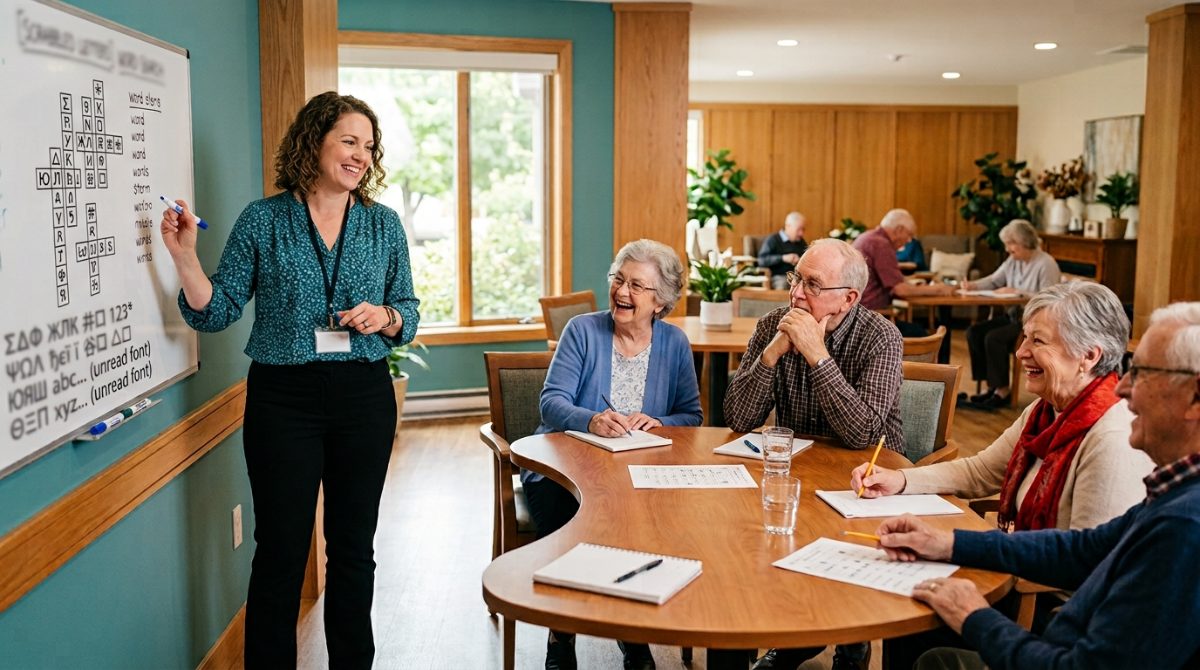
4. Logic, numbers & problem solving
- Sudoku (easy, large grid) — 4×4 or 6×6 grids are the right entry point, not 9×9.
- Mental math ladders — start at 2, double it, add 10, halve it… call the steps slowly.
- Riddles & brain teasers — one per day at lunch builds a following (“What has hands but cannot clap?”).
- Sequence puzzles — what comes next: 2, 4, 8, 16…?
- Price Is Right estimating — guess grocery prices; math practice disguised as nostalgia.
5. Novelty & cross-training (the underrated one)
The brain benefits most from what it hasn’t done before. These “cross-training” exercises look simple but light up new pathways:
- Non-dominant hand practice — write your name or brush your hair with the other hand.
- Learn 5 words in a new language — count to five in Italian this week, greet in Spanish next.
- New-skill demos — a resident or staff member teaches something simple: a knot, a card trick, a dance step.
A ready-made weekly brain fitness plan
Drop this straight into your calendar — 15 minutes a day, rotating muscle groups:
- Monday: Attention — odd one out + clap the pattern
- Tuesday: Language — word fluency sprints + alphabet categories
- Wednesday: Memory — tray memory + finish the phrase (the dementia-friendly rounds in our trivia for seniors set drop straight in here)
- Thursday: Logic — riddle of the day + easy sudoku or estimating game
- Friday: Novelty — non-dominant hand art + new language words
- Weekend: Social play — any group game from our 33 games for seniors; social games are brain exercise with dessert.
Pro tip: pair mental and physical exercise. Ten minutes of chair exercises before brain training increases blood flow and measurably improves session engagement.
What actually matters (and what doesn’t)
- Consistency beats intensity. Fifteen minutes daily outperforms one long weekly session.
- Novelty beats repetition. The 500th identical crossword trains less than a puzzle type you’ve never tried.
- Social beats solo. Conversation is itself a demanding cognitive workout — group formats double the benefit.
- Fun beats rigor. The best brain exercise is the one residents show up for voluntarily, smiling.
Make brain fitness a program, not an event
ActivityBuilder gives you TV-ready brain games — trivia, memory match, word games, Jeopardy — plus a drag-and-drop calendar to schedule the weekly plan above and attendance tracking to show families the program is real. Brain workouts also anchor the rainy-day rotation in our indoor activities for seniors guide. Start a free trial and launch your brain fitness week today.
Frequently Asked Questions
What is the best brain exercise for seniors?+
There is no single best one — the biggest gains come from variety and consistency. A strong program rotates attention games, verbal fluency sprints, memory recall, logic puzzles, and novel skills, 15 minutes a day, ideally in a social group setting.
Can brain exercises prevent dementia?+
No exercise can guarantee prevention, but regular cognitive stimulation, social engagement, and physical activity are consistently associated with lower risk and better daily function. Think of brain exercises as one pillar of brain health alongside movement, sleep, and social connection.
What are free brain exercises for seniors?+
Most of the best ones cost nothing: word fluency sprints, alphabet categories, tray-memory games, riddle-of-the-day, backwards spelling, non-dominant-hand practice, and finish-the-phrase all need no materials beyond household items and a whiteboard.
How often should seniors do brain exercises?+
Daily short sessions work best — about 15 minutes, rotating different types of challenges through the week. Consistency and novelty matter more than difficulty or session length.
Stop planning from scratch
ActivityBuilder gives you 580+ ready-to-use activities, 30+ in-browser games, and a drag-and-drop calendar builder — everything in this article, done for you.
Start your 7-day free trial →